First Machalilla Book Fair
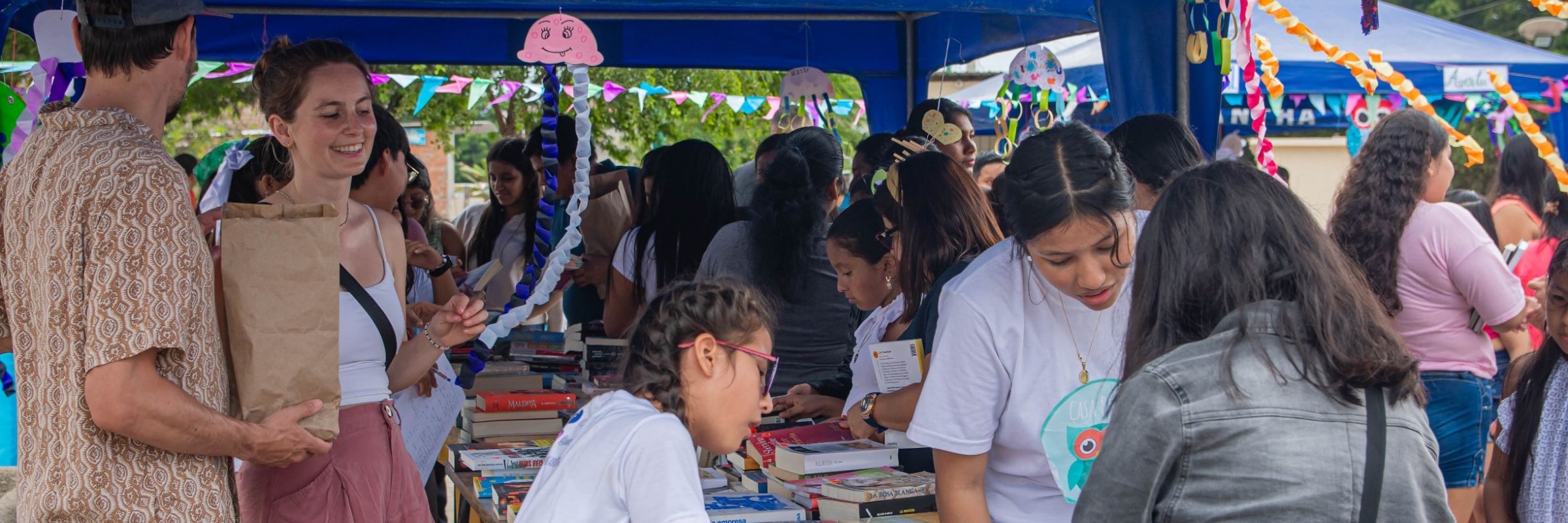
The First Machalilla Book Fair marked a historic milestone for the parish and for Casa Búho. It was the first time the community had a literary event of this magnitude, designed specifically to bring books, authors, and cultural experiences closer to children, teenagers, and families in the territory.
The fair brought together reading mediators, artistic presentations, children's activities, youth clubs, dialogue spaces, and book exhibitions. More than a sales event, it was a celebration of the right to read. For several days, Machalilla was transformed into a territory of stories, creativity, and critical thinking.
This fair was made possible thanks to the coordinated work of Colectivo La Colmena, a cultural network of which Casa Búho is an active member alongside Yo Amo Leer, Libroteca Imaginada, Gato Encerrado Lectura Viva, and Yuyarina Pacha. The collective effort between these projects allowed for a diverse, solid, and culturally significant program for the community.
More than a sum of organizations, La Colmena represents a shared vision: strengthening local culture through cooperation, mutual respect, and commitment to democratic access to books and art. The fair showed that when cultural initiatives in the territory recognize themselves as a network, the impact is amplified and the community responds.
The active participation of the Big Búhos was also central. Young people who grew up reading at Casa Búho took on leadership, logistics, and mediation roles, demonstrating the continuity and depth of the project.
The First Book Fair was not just a cultural event. It was the tangible expression of a community that understands that reading is a right, that culture is a collective act, and that working as a network can transform the symbolic horizon of a territory.
Participation in Machalilla's Sardine Fair
Casa Búho's participation in the Sardine Fair represents a powerful symbolic gesture: integrating reading into a celebration that is deeply tied to the community's identity.
At an event traditionally linked to gastronomy and the local economy, Casa Búho set up a reading and literary mediation space, demonstrating that written culture can dialogue with popular culture. Children and families who attended the fair by tradition also found stories, read-alouds, and creative activities.
This presence allowed us to reach new audiences, connect with families who might not regularly visit the library, and reaffirm that reading can inhabit any community space. It wasn't about isolating literature in a corner, but integrating it organically into social life.
The experience showed that when reading becomes visible in festive spaces, it becomes normalized as part of everyday life. Casa Búho doesn't always wait for families to come to the library; it goes out into the territory, accompanies celebrations, and builds culture where the community is already gathered.
Family Events
Family Kermés for Children's Day
The Family Kermés for Children's Day was conceived as a celebration of play, creativity, and the right to imagine. Through playful stations, literary dynamics, cooperative challenges, and artistic activities, families shared a day designed to strengthen emotional bonds.
Each station integrated reading and play: challenges inspired by stories, oral expression dynamics, sensory activities for the youngest, and collective creation spaces. The intention was not just to entertain, but to show how play and literature can become tools for emotional and cognitive development.
The kermés reaffirmed that meaningful learning happens when there is joy and connection. Mothers and fathers participated actively, not as spectators, but as mediators alongside their children. This experience helped families see reading as a natural part of shared time.
Dinosaur Party
The Dinosaur Party was a themed celebration that combined science, imagination, and literature. Inspired by illustrated books and informational texts, the day included dramatized readings, costumes, symbolic excavation activities, and creative workshops.
Beyond play, the party promoted scientific curiosity and vocabulary expansion. Children explored concepts about prehistory while strengthening narrative and expressive skills.
This type of themed event allows reading to transcend the physical book and become an immersive experience. Fantasy and knowledge come together, creating memorable learning.
Caveman Party
The Caveman Party extended the prehistoric universe into a deeper sensory and artistic experience. Participants recreated scenes from ancient life, created cave art, and explored narratives about the first human beings.
The event allowed connecting history, creativity, and collaborative work. Teenagers supported the mediation, consolidating Casa Búho's intergenerational approach.
The party showed how themed events can be vehicles for integrating art, history, and reading into a single meaningful experience.
Halloween Party
The Halloween Party was an opportunity to work with fantasy literature and oral storytelling. Read-alouds were held with special atmosphere, mystery story creation, and creative writing activities.
The event allowed exploring emotions like fear from a safe and creative environment. It also strengthened the expressive confidence of children and teenagers.
Reading became a bridge between imagination and emotional reflection.
Literary Chocolate
The Literary Chocolate is one of Casa Búho's most intimate and symbolic gatherings. It is not simply a shared reading around a warm cup; it is a space where literature becomes conversation, play, reinterpretation, and collective experience.
In one of its most memorable editions, we imagined that William Shakespeare was visiting Machalilla. From that playful gesture, the Big Búhos group reinterpreted Romeo and Juliet for our territory. The work was developed and inspired by the illustrated book by Mercè López, whose visual approach allowed the classic to be brought closer to a more accessible and contemporary language.
The dynamic was not a simple dramatized reading. It was an exercise in cultural appropriation. What would happen if Romeo and Juliet walked through our streets? How would tragic love sound in a coastal community? What young voices would embody that universal story?
The Big Búhos took on the interpretation with depth and creativity, demonstrating that the classics do not belong exclusively to grand theatres or academic books, but can dialogue with young readers from a rural parish. Literature stopped being distant and became close, alive, and situated.
The audience—children, mothers, fathers, and neighbors—was not a passive spectator. They participated, commented, laughed, reflected. The shared chocolate worked as a symbol of community: warmth, encounter, and conversation.
That Literary Chocolate showed something essential about Casa Búho: here books are not consumed, they are inhabited. Teenagers don't repeat texts; they reinterpret them. And the classics are not revered from a distance; they are brought into the present and made one's own.
It was a night when Machalilla didn't just read Shakespeare. It invited him to sit at the table.
Nutrition Month
Nutrition Month was one of the most comprehensive and participatory experiences at Casa Búho in recent years. It was not just a cooking cycle or a series of themed workshops; it was an opportunity to understand the body, food, and care from an educational, emotional, and community perspective.
Throughout the month, we didn't just cook and share delicious preparations—we learned deeply about how our bodies work, what they need to grow healthy, and how food impacts our energy, concentration, and well-being. Reading was the starting point: informational books, stories related to care, and guided conversations connecting knowledge with everyday experience.
The most beautiful part was the collective dimension of learning. Mothers shared their knowledge with children and teenagers; some taught traditional recipes, others talked about nutritious combinations and household habits. Older women contributed inherited advice, culinary memories, and care practices that connected generations.
The culminating moment was the participation of a professional chef from the area, who offered a master class combining technique, creativity, and food awareness. Her presence elevated the experience and showed that the community has local talent willing to contribute when a meaningful space exists.
This month reaffirmed something essential at Casa Búho: literacy is not limited to reading books—it also means learning to "read" the body, understanding labels, interpreting nutritional information, and making informed decisions.
Nutrition Month showed that when knowledge flows horizontally—between mothers, young people, children, and professionals—the community doesn't just learn. It grows stronger.